
Breast Implant Placement: Submuscular, Subglandular or Dual Plane?
Clinical decision guide for breast implant placement in Tehran: submuscular, subglandular, dual-plane, tissue thickness, athletes and natural-looking outcomes.
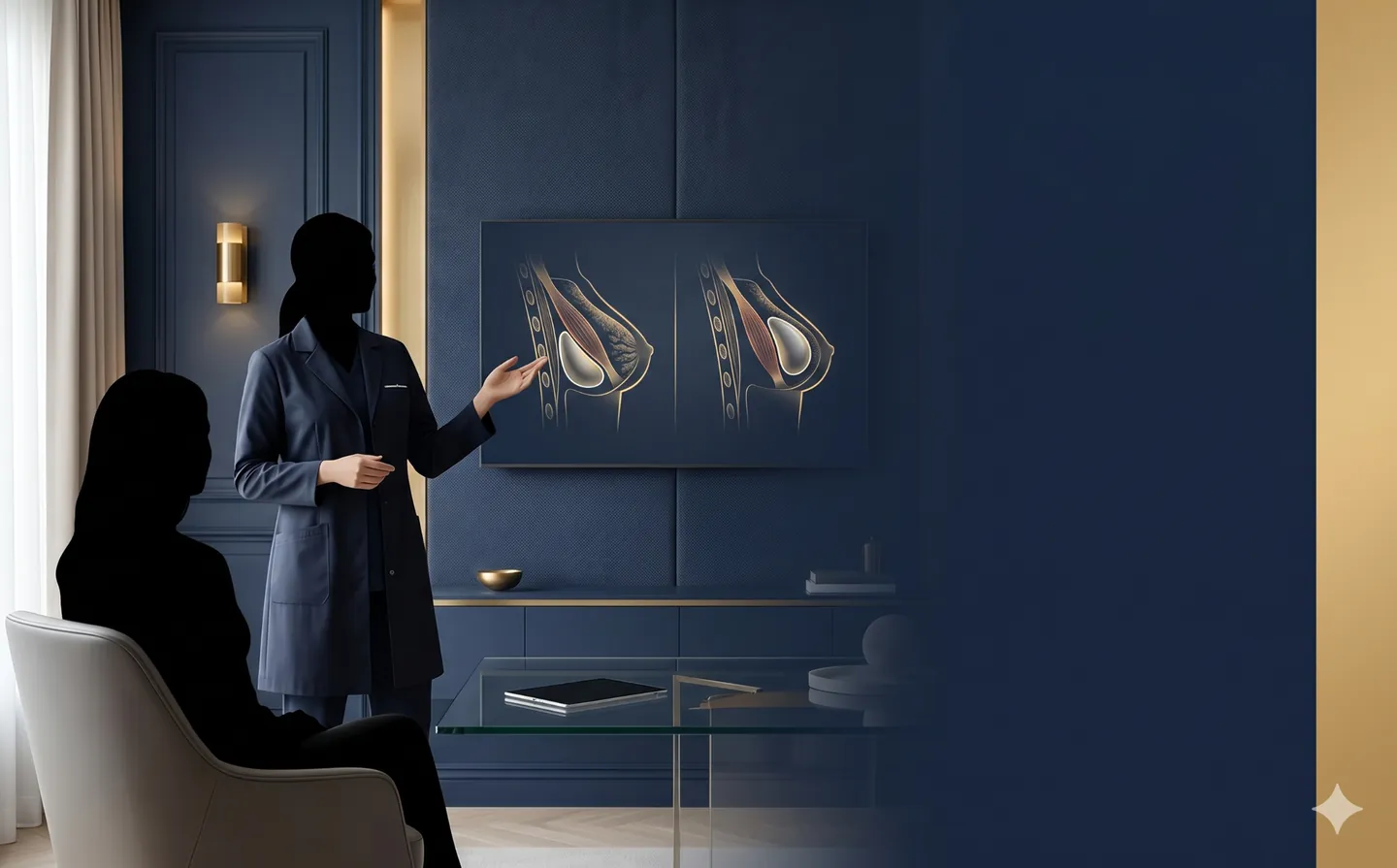
Why implant placement matters
Breast implant placement is not a cosmetic detail. The layer in which the implant is placed affects the upper-pole slope, tissue coverage, palpability, mammography handling, athletic movement and long-term appearance. A decision based only on size or brand ignores the anatomical variables that usually determine whether the result looks natural or artificial.
Subglandular placement
In subglandular placement, the implant sits beneath the breast gland and above the pectoralis major muscle. It may be considered when the patient has adequate soft-tissue coverage, stronger skin quality and a lifestyle where muscle distortion should be minimized. It often involves a lighter muscular recovery, but it can expose implant edges or rippling in very thin patients.
Submuscular placement
In submuscular placement, the implant is placed deeper, behind the pectoralis major muscle. This can improve upper-pole camouflage in lean patients and may reduce visible implant edges. The trade-off is more muscle-related discomfort during early recovery and possible animation deformity during strong pectoral contraction.
Dual-plane technique
Dual-plane placement combines aspects of both approaches. The upper implant is covered by muscle while the lower pole can expand more naturally. It is not a universal solution; it requires careful anatomical planning and surgeon experience.
Decision variables
The key variables are tissue thickness, chest width, skin elasticity, degree of ptosis, athletic activity and desired naturalness. If true breast sagging exists, implant placement alone does not correct it; breast lift planning may be required.
Key decision table
| Clinical question | What should be evaluated |
|---|---|
| Main tissue problem | Fat, loose skin, gland position, muscle wall or mixed anatomy |
| Patient safety | Medical history, facility, anesthesia and recovery plan |
| Surgeon selection | Credential verification, realistic planning and follow-up |
Clinical note
Dr. Arash Najaf-Beigi is a Tehran-based plastic, reconstructive and aesthetic surgeon. Patients can review professional identity through Iran’s Medical Council public profile and the Iranian Society of Plastic and Aesthetic Surgeons directory.
Frequently asked questions
Is submuscular placement always better?
No. It can be helpful for thin patients with limited soft-tissue coverage, but it may not be ideal for all athletes or all anatomies.
What is dual-plane placement?
A hybrid technique in which the upper implant is covered by muscle while the lower pole can expand more freely.
Can placement correct sagging?
No. True ptosis usually requires breast lift planning, with or without an implant.